
National Monument at Vítkov
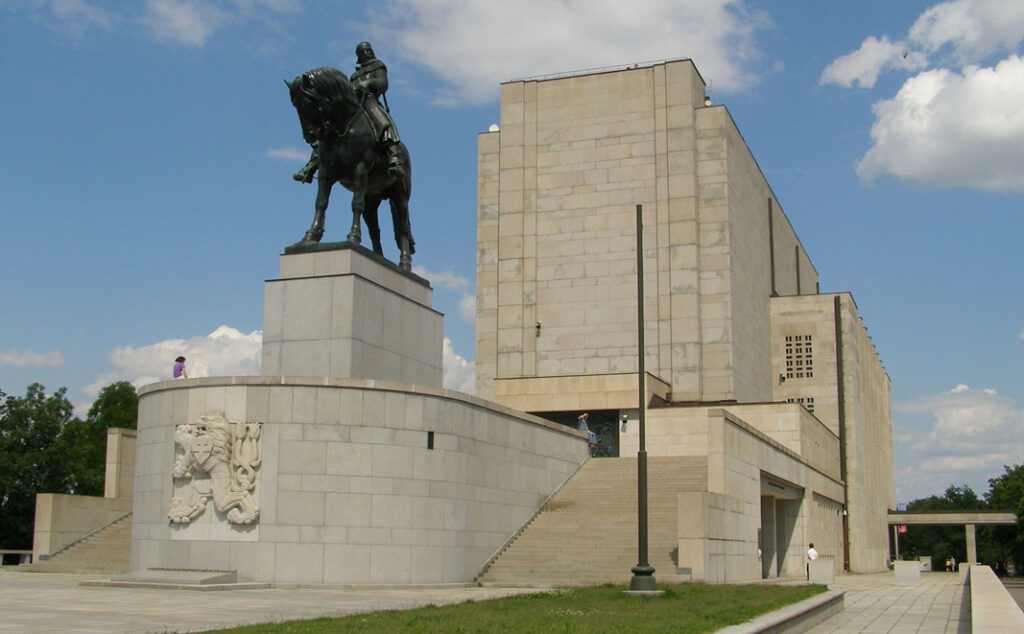
The National Monument on Vítkov is a First Republic functionalist monument, the rough construction of which, no. 1900, was built in Prague on Vítkov Hill in Žižkov in 1929–1933 according to the design of the architect Jan Zázvorka the Elder.Work on the monument began in 1929 and the rough construction was completed four years later in 1933. There was no ceremonial opening on the 20th anniversary of the republic. The main purpose was to honor the memory of the Czechoslovak legionnaires and the Czechoslovak resistance during the First World War (1914–1918).It was expanded in 1946–1949. Between 1954–1962, the mausoleum of Klement Gottwald was located here. Now, only the remains of the unknown soldier from the Battle of Zborov and the Dukla operation are stored in the columbarium of the memorial under the statue of Jan Žižka.
Karlín Barracks
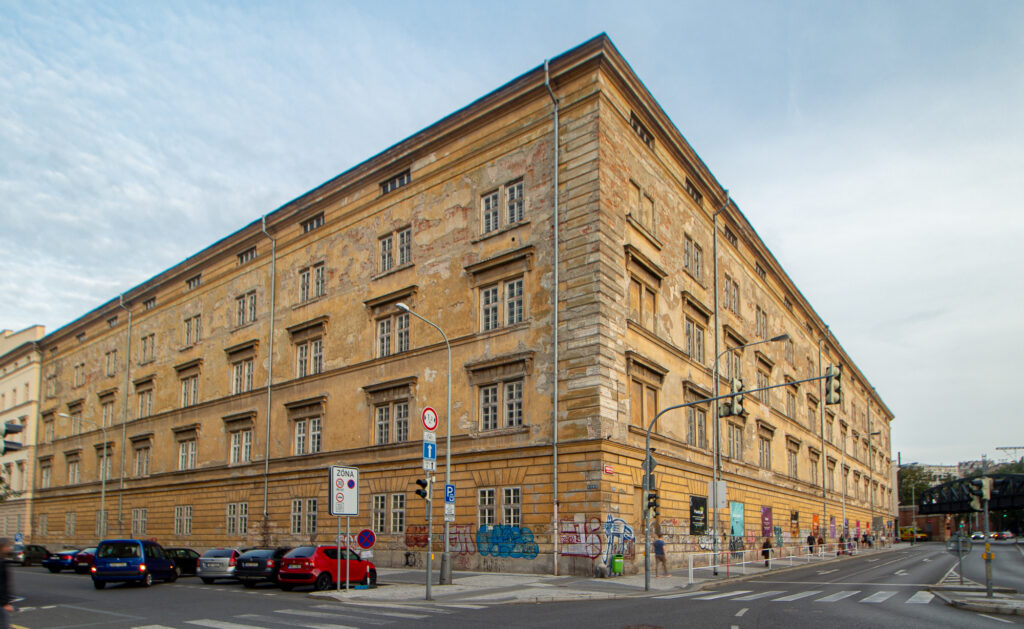
Karlín Barracks (also Karlín Barracks, Ferdinand Barracks or Karlín Barracks of Jan Žižka z Trocnov, during World War II Hindenburg Barracks) is a historic classicist five-story building located in Prague 8 in the Karlín district. It has entrances from Prvního pluku, Křižíkova and Vítkova streets, and is closely adjacent to Vítkov Hill and the Negrelli Viaduct. Before 2008, various units and facilities of the Prague military garrison were located here, such as the garrison band, military police, headquarters or infirmary. They are protected as a cultural monument of the Czech Republic.
Negrelli Viaduct
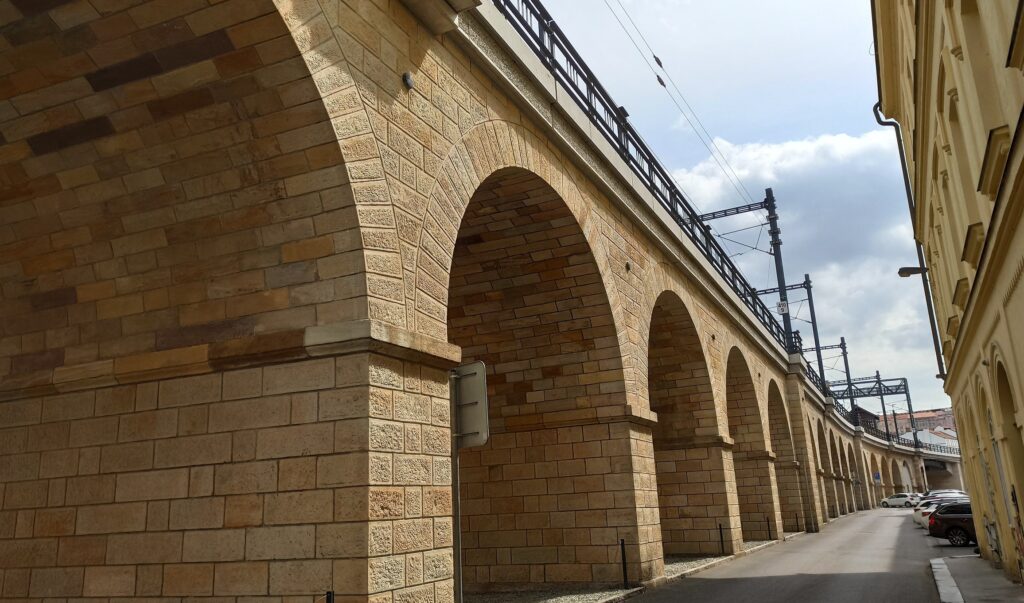
Negrelli Viaduct (also called Karlín Viaduct, formerly generally the State Railway Company Viaduct) is a railway bridge over the Vltava River and a viaduct in Karlín, which connects Masaryk Station in Prague across the island of Štvanice with Bubny, named after its builder Alois Negrelli. It is historically the first Prague railway bridge and the second oldest preserved Prague bridge over the Vltava River, the thirteenth in order along the Vltava River. With a length of 1,120 m, it is the longest railway bridge and the fourth longest bridge overall in the Czech Republic. Until 1910, it was the longest bridge in Europe and is still the longest railway bridge in Central Europe.The beginning of the viaduct lies in the part of Nové Město falling into Prague 8. Above the Florenc bus station, it forms the border between Nové Město and Karlín, then continues through the territory of Karlín across the Vltava island of Štvanice to the Bubny part of Holešovice.